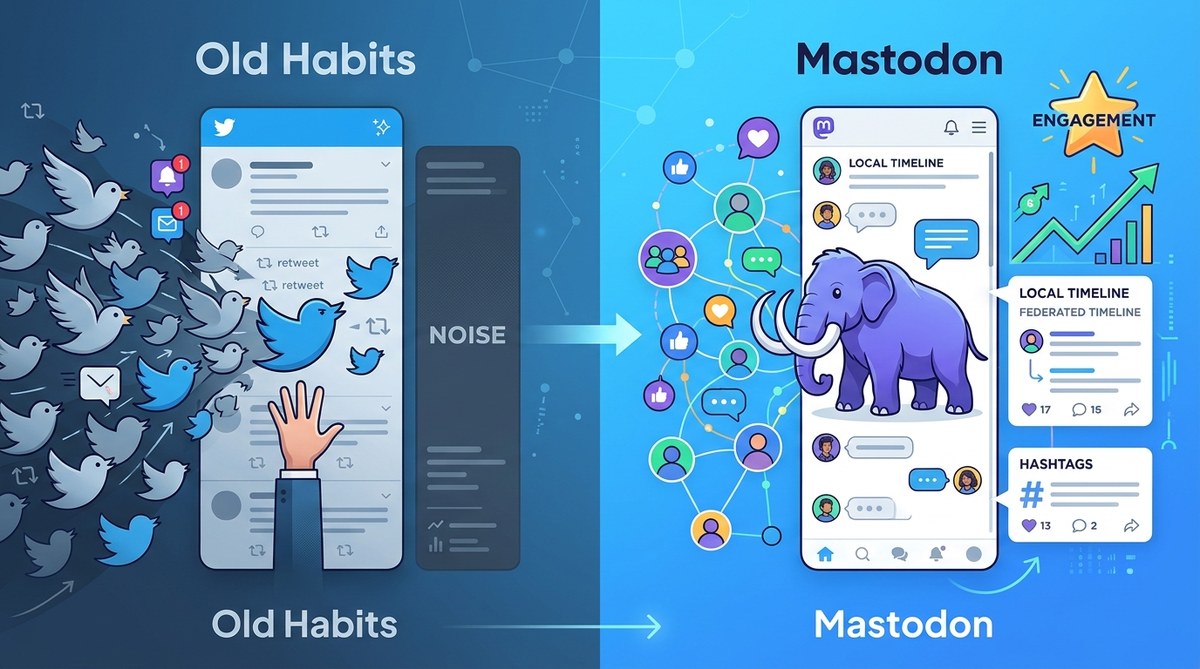
You just moved to a new city. The coffee shops are different. The streets have no names you recognize. People don’t honk at each other. You try to order your usual drink, and the barista looks confused. That is exactly what it feels like when you bring your Twitter habits to Mastodon. You post a hot take. You drop a link. You wait for the likes to roll in. Nothing happens. You are not alone. This is the single most common frustration for every Twitter migrant, and it has a simple fix. You are playing the wrong game.
Mastodon is not a broadcast platform. It is a community platform. The biggest mistake new users make is treating their feed like a megaphone. To get engagement, you must stop optimizing for the algorithm and start optimizing for conversation. This guide gives you the exact Mastodon engagement tips you need to unlearn Twitter habits and build real traction in 2026.
Why Your Old Twitter Playbook Fails Here
Twitter was built for speed. Short bursts. Global reach. The algorithm decided what you saw, and it rewarded outrage, hot takes, and link dropping. You could post a link to your blog at 9:00 AM and get a hundred clicks by lunch without saying a single original word.
Mastodon works differently. There is no master algorithm pushing your content to strangers. Your posts only reach people who follow you, plus anyone browsing the federated or local timeline on your server. That is a huge difference. On Twitter, you shouted into a crowd. On Mastodon, you speak to a room.
If you keep posting like you are on Twitter, you will be ignored. Not because people are mean. Because your content does not fit the room.
The Three Habits That Kill Your Engagement
Let us name the specific behaviors that are hurting you. These are the most common traps for new users.
- Link dropping without context. You paste a URL and hit post. On Twitter, that worked because the algorithm pushed it. On Mastodon, people scroll past it. They want to know why you shared it. What do you think about it? What is the conversation you are trying to start?
- Posting and leaving. You fire off a toot and close the app. On Twitter, engagement happened in the first ten minutes or not at all. On Mastodon, conversations unfold over hours or days. If you do not stick around to reply, you look like a bot.
- Using hashtags like keywords. Hashtags on Mastodon are not search engine keywords. They are community markers. If you spam unrelated hashtags, you will get muted or blocked.
These three habits are the biggest reasons new users feel invisible. Let us fix them.
How to Rewire Your Brain for the Fediverse
You need a new approach. Think of Mastodon as a dinner party, not a stadium concert. You would not walk into a dinner party, drop a business card on the table, and walk out. You would introduce yourself. You would listen. You would ask questions.
Here is a practical process to shift your mindset.
- Start with a personal introduction. Your first few posts should tell people who you are and what you care about. Do not just say “writer.” Say “I write about urban gardening and I am obsessed with heirloom tomatoes.” That gives people a hook.
- Reply before you post. Spend your first ten minutes on the app replying to other people. Add value to their conversations. That builds social capital.
- Share your opinion, not just the link. When you share an article, write a sentence about what you learned or why you disagree. That invites a response.
- Use content warnings thoughtfully. Content warnings are not just for sensitive topics. They are a tool for respect. Use them for long posts, spoilers, or anything that might not be what someone wants to see while eating lunch.
- Engage with your local timeline. Your instance’s local timeline is the best place to find people who share your interests. Comment on their posts. Build relationships.
The Engagement Mistake Table
Here is a side by side comparison of what does not work versus what does.
| Old Twitter Habit | Mastodon Alternative | Why It Works |
|---|---|---|
| Post a bare link with no text | Add a personal take or a question | Invites conversation instead of passive consumption |
| Use trending hashtags | Use niche community hashtags | Reaches people who actually care about your topic |
| Post multiple times a day | Post fewer, higher quality posts | Quality signals respect for the reader’s attention |
| Ignore replies | Reply to every comment | Builds relationships and boosts your visibility |
| Follow thousands of accounts | Follow a focused group of active users | Keeps your feed manageable and your interactions meaningful |
This table is your cheat sheet. Print it. Stick it on your monitor. Refer to it every time you feel the old habits creeping back.
The Secret Weapon: The Local Timeline
Most Twitter migrants ignore the local timeline. That is a mistake. The local timeline shows posts from everyone on your server. It is the closest thing Mastodon has to a community square.
“The local timeline is where the magic happens. It is where you find the people who will become your actual friends, not just your followers.” — An active Mastodon user since 2022.
Spend time there. Reply to people. Share your own posts there too. The local timeline is where you build the foundation of your network. Once you have a core group of mutuals, your engagement will grow naturally because those people will boost your posts to their own followers.
Three Tools to Make This Easier
You do not have to do all of this manually. A few tools can help you build better habits.
- Use a good Mastodon client. Apps like Mammoth make it easier to see your local timeline and manage replies. They are designed for the Fediverse, not for Twitter.
- Set a reply reminder. If you tend to post and run, set a timer for 30 minutes later. Come back and see if anyone responded. Treat it like a conversation.
- Track your engagement patterns. Look at which posts got the most replies, not likes. Likes are nice. Replies are gold. They mean someone cared enough to talk to you.
For more on the tools that make Mastodon better, check out our guide on essential apps for navigating the decentralized social web.
The Long Game: Building a Real Audience
Growing on Mastodon takes time. That is not a bug. It is a feature. The platform is designed to reward genuine connection over viral growth. Here is what that looks like in practice.
- Be consistent, not loud. Post a few times a day. Engage with the same people regularly. Show up.
- Share other people’s work. Boosting someone else’s post is one of the best ways to build goodwill. It also shows you are paying attention.
- Write longer posts. Mastodon allows up to 500 characters by default, and many instances allow more. Use that space. Tell stories. Explain your thinking.
- Join a niche instance. If you are on a general instance like mastodon.social, you are competing with millions of users. If you join a server focused on your interest, like writing or photography, your posts will be seen by a smaller, more relevant audience.
If you are still choosing a server, read our guide on why your mastodon instance choice defines your social experience to make sure you pick the right home.
Stop Treating Mastodon Like Twitter
Mastodon is not a worse Twitter. It is a different thing entirely. It is slower. It is more personal. It rewards thoughtfulness over speed. If you can accept that difference, you will not only get more engagement. You will actually enjoy the platform more.
The people who thrive on Mastodon are the ones who treat it like a neighborhood. They wave at their neighbors. They share what they are cooking. They ask for recommendations. They do not try to go viral. They try to belong.
Start tomorrow with one change. Before you post anything, ask yourself: “Would I say this at a dinner table?” If the answer is no, rewrite it. If the answer is yes, hit post. Then stay for the conversation.
For a broader look at where all of this is heading, read our piece on why mastodon is the social network you should join in 2026. It will help you see the bigger picture and stay motivated as you build your presence.